Journal of Iranian Plant Protection Research

Journal of Iranian Plant Protection Research

Journal of Iranian Plant Protection Research, is an open access double-blind peer-reviewed Journal which is published by Ferdowsi University of Mashhad. The Journal welcomes the papers in all aspects of plant protection science. Subjects covered in this Journal include: Agricultural Entomology, Acarology, Bacteriology, Mycology, Nematology, Virology, and Weed Science. Full-length original articles, Short Communications, and critical reviews are welcomed. Contributions must be original and must not have been submitted for publication elsewhere. The manuscript should be submitted to the journal through the Submit Paper system.  This journal is a member of Committee on Publication Ethics (COPE) and complies with the highest ethical standards in accordance with ethical laws. Authors of the article are required to observe scientific ethics and publication in accordance with the instructions of this committee. The Journal (IJPPR) utilizes "iThenticate Plagiarism Detection Software" for checking the originality of submitted papers in the reviewing process.

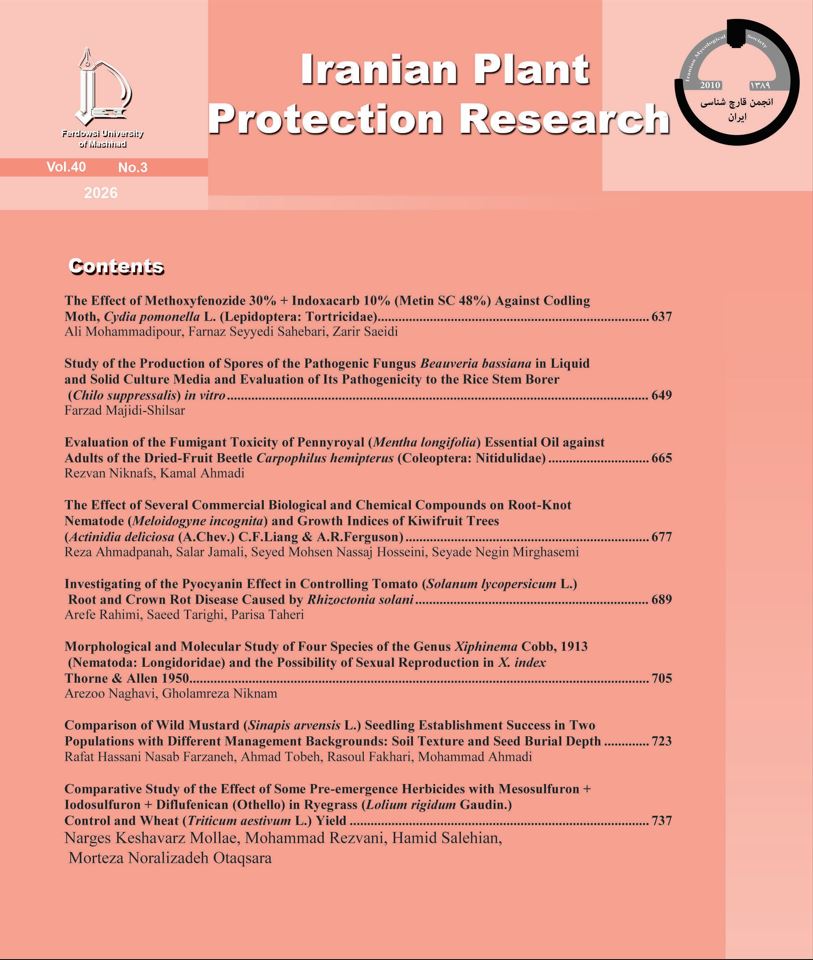
Current Issue: Volume 40, Issue 3 - Serial Number 73, Summer 2026, Pages 637-749 

Keywords Cloud

  • Biological control
  • Herbicide
  • Resistance
  • Weed
  • Chemical control
  • Competition
  • Iran
  • Density
  • Germination
  • Dry weight
  • Phylogenetic analysis
  • Tomato
  • RT-PCR
  • wheat
  • Fauna
  • yield
  • Root-knot nematode
  • Allelopathy
  • Bioassay
  • Soybean
  • Sustainable agriculture
  • PCR
  • DAS-ELISA
  • Germination rate
  • Weed control
  • temperature
  • Rice
  • Weed density
  • Sugar beet
  • Seed dormancy
  • Parasitoid
  • Mulch
  • trifluralin
  • Weeds
  • Frequency
  • Surface tension
  • Biomass
  • morphology
  • grain yield
  • Secondary metabolites
  • Trichoderma
  • Cardinal temperatures
  • barley
  • ELISA
  • Yield loss
  • Fungicide
  • Interference
  • Detection
  • Life table
  • Medicinal plants
  • Adjuvant
  • Grapevine
  • distribution
  • Integrated Weed Management
  • Efficacy
  • nematode
  • Agonoscena pistaciae
  • Seed
  • Coat protein
  • Tolerance
  • Mazandaran
  • Surfactant
  • Citrus
  • Total phenol
  • Powdery Mildew
  • Weed biomass
  • weed management
  • Potato
  • ABSTRACT
  • Bean
  • Dose-Response
  • Microcerotermes diversus
  • Biocontrol
  • Population dynamics
  • Genetic diversity
  • Adjuvants
  • spatial distribution
  • Natural enemies
  • Germination percentage
  • Kurdistan
  • Damage
  • Chrysoperla carnea
  • Mortality
  • plant parasitic nematodes
  • Biology
  • Repellency
  • Meloidogyne javanica
  • Weed dry weight
  • mass rearing
  • Emergence
  • Greenhouse
  • Essential oil
  • phylogeny
  • management
  • Diversity
  • Khorasan Razavi
  • Effective dose
  • Rhizoctonia solani
  • Parasitism
  • Nicosulfuron
  • Vegetable oil
  • Identification
  • Predator
  • Hand weeding
  • Population growth parameters
  • two-spotted spider mite
  • Squash mosaic virus
  • Sirinol
  • Aphis gossypii
  • Pistachio
  • Greenhouse Whitefly
  • rapeseed
  • Phytoplasma
  • Control
  • Pendimethalin
  • Functional response
  • Thrips
  • Fusarium
  • a
  • Screening
  • Cucumber
  • Essential oils
  • Pesticide
  • Arbuscular mycorrhizal fungi
  • Intrinsic rate of increase
  • Antibiosis
  • Cloning
  • Plant height
  • Planting density
  • Apple
  • integrated pest management
  • Disease Severity
  • susceptibility
  • wild barley
  • Tomato cultivars
  • Conservation tillage
  • Half-life
  • Mashhad
  • Population fluctuations
  • Invasive plant
  • Modeling
  • Codling Moth
  • corn
  • Tillage
  • Palizin
  • Demographic parameters
  • Biological degradation
  • Biological parameters
  • Biodiversity
  • Fungi
  • Potyvirus
  • Phenol
  • Cold storage
  • Macrophomina phaseolina
  • Phytophthora
  • Dose response
  • Erysiphe necator
  • Uniformity
  • Bemisia tabaci
  • Visual injury
  • Abundance Index
  • Herbicide efficacy
  • Vegetable oils
  • Sulfosulfuron
  • Whitefly
  • Population Growth
  • Chlorophyll fluorescence
  • salinity
  • Synergistic effect
  • Regression Models
  • Vetch
  • Host Preference
  • Root rot
  • Herbicide dose
  • Gall midge
  • sulfur
  • Alfalfa
  • Sorghum
  • Planting date
  • Toxicity
  • Cover crops
  • Polymerase chain reaction
  • Antioxidant enzymes
  • Non-chemical management
  • Cardinal temperature
  • Chickpea
  • Salinity stress
  • Herbicide resistance
  • Distribution map
  • Genotype
  • Weed interference
  • Synergism
  • Seed bank
  • Metribuzin
  • Antagonism
  • Non-chemical control
  • Pesticides
  • Sulfuric acid
  • Antixenosis
  • extract

Related Journals