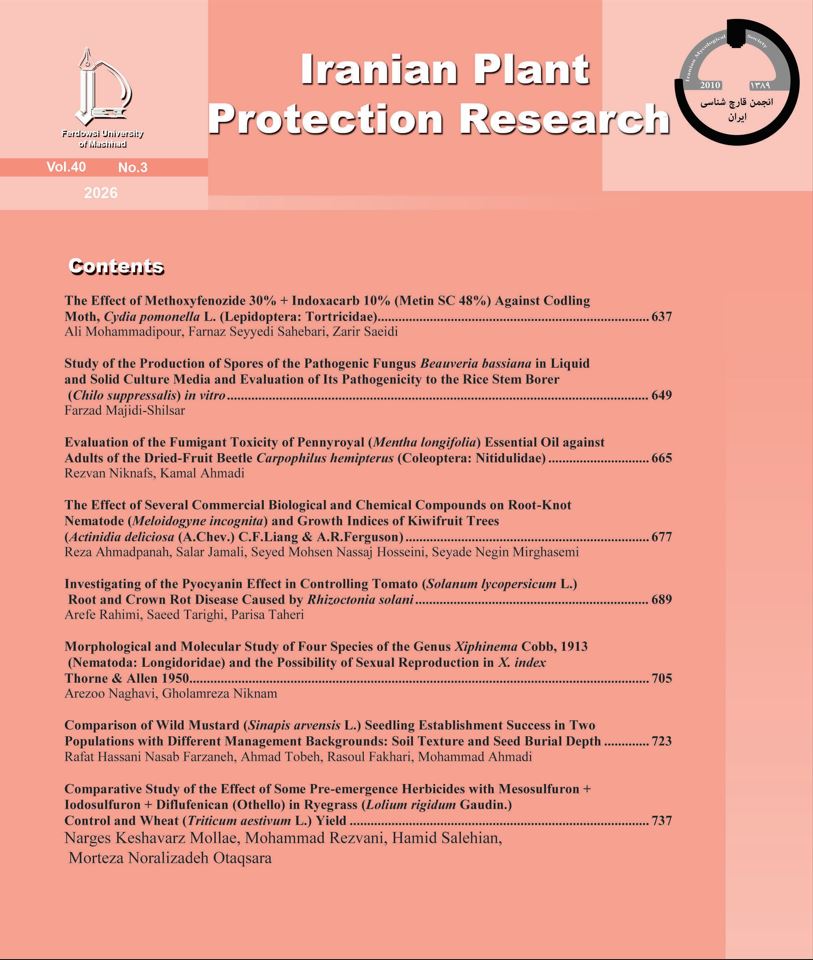
Document Type : Research Article
Authors
1
Department of Plant Protection, Faculty of Agricultural Sciences, University of Guilan, Rasht, Iran
2
2- Academic Center for Education, culture and Research, Guilan Province, Rasht, Iran
Abstract
Introduction
Root-knot nematodes (Meloidogyne spp.) are among the most widespread and economically important plant-parasitic nematodes. They have a broad host range and are sedentary endoparasites that cause severe damage to crops.. These nematodes induce root galls, impairing the absorption of water and nutrients and consequently reducing kiwifruit (Actinidia deliciosa (A.Chev.) C.F.Liang & A.R.Ferguson) yield and qualityAlthough chemical nematicides are effective in controlling root-knot nematodes, their use is limited due to negative environmental consequences, the emergence of resistance, and adverse effects on human health. Therefore, in recent years, the use of biological compounds such as antagonistic bacteria, nematode-pathogenic fungi, and plant compounds has been considered as a sustainable and environmentally friendly solution. This study aimed to compare the effectiveness of biological and chemical compounds in controlling this nematode and to investigate their effects on kiwifruit trees under orchard conditions.
Materials and Methods
Soil and root samples were collected from kiwifruit orchards exhibiting symptoms of nematode infection, including leaf yellowing and wilting and the presence of root galls.The numbers of eggs, root galls, and egg masses were determined in the root systems, and the population density of second-stage juveniles (J2) was determined in soil samples.. Morphometric diagnosis was performed by preparing microscopic slides of second-stage juveniles and cutting the cuticular network at the end of the body of female nematodes. Identification of the nematode species was performed. After determining the population, the orchard with the highest contamination level and the most similar conditions (tree age, row spacing, soil type, and land slope) was selected for the experiment. This study was conducted in a randomized complete block design with 10 treatments and 3 replications in a kiwifruit orchard located in Siahkal Rudkhani village, Rudsar city, Gilan province. The experimental treatments included control, two different levels of each of the biofertilizers and organic compounds, including Nemacob, Nemacob Plus at two levels (150 and 300 mL/m2), Bactoland as a biofertilizer containing rhizosphere growth-promoting bacteria and humic acid at 100 and 200 mL m-2, Biolap as a biological pesticide at 15 and 25 mL m-2and Cadosphos (Rugby) 10%WG as a chemical treatment. All treatments were applied in the tree canopy zone throughout the entire growing cycle. The evaluated indices included the number of galls, eggs and larvae, egg sacs in the root, second-stage juveniles (J2) in soil, nematode reproductive factor, and fruit traits including weight, length, and diameter.
Results and discussion
Based on the morphological and morphometric characteristics of the second-stage juveniles and perineal pattern of the female nematodes, the studied species was identified as Meloidogyne incognita. Results showed that all treatments significantly (at the 1% level) reduced nematode pathogenicity indices but had no significant effect on fruit weight and length. All compounds led to a significant reduction in the population of second-stage juveniles in the soil (up to 89.4%), number of root galls (18.8-61.1%), number of egg sacs (37.2-77.7%), and reproduction factor (2.5 in the control to 0.4-0.5 in the treatments). Bactoland at 200 mL/m² achieved the greatest reduction in nematode indices, while Biolap at 15 mL/m² was the least effective. The treatments had no significant effect on fruit weight and length (P>0.05). Regarding the increase in fruit width, Nemacob 300 mL/m² (2.5 cm) and Rugby (1.5 cm) had the greatest effect and showed a significant increase compared to the control (9.4 cm).
Conclusion
The results demonstrated that both biological and chemical treatments significantly reduced nematode population and pathogenicity indices under orchard conditions.. Although these compounds did not have much effect on fruit growth traits, especially fruit weight and length, the time frame of the study is also important in increasing the yield of perennial fruit trees. The use of biological compounds such as Bactoland was very effective in reducing nematode density. The superiority of Bactoland can be attributed to the presence of plant growth-promoting bacteria (PGPR) such as Bacillus subtilis and Pseudomonas spp., which play a role in suppressing nematode populations through mechanisms such as production of secondary metabolites, nematode cell wall-lyzing enzymes (such as chitinase and protease), secretion of siderophores, and induction of systemic resistance. The present findings indicated that increasing the concentration of treatments improved the effectiveness in reducing pathogenicity indices, although this increase did not have a significant effect on fruit growth, especially in terms of weight and length. Biological compounds are preferable due to their desirable effectiveness and lower ecological impacts.
Keywords
Subjects