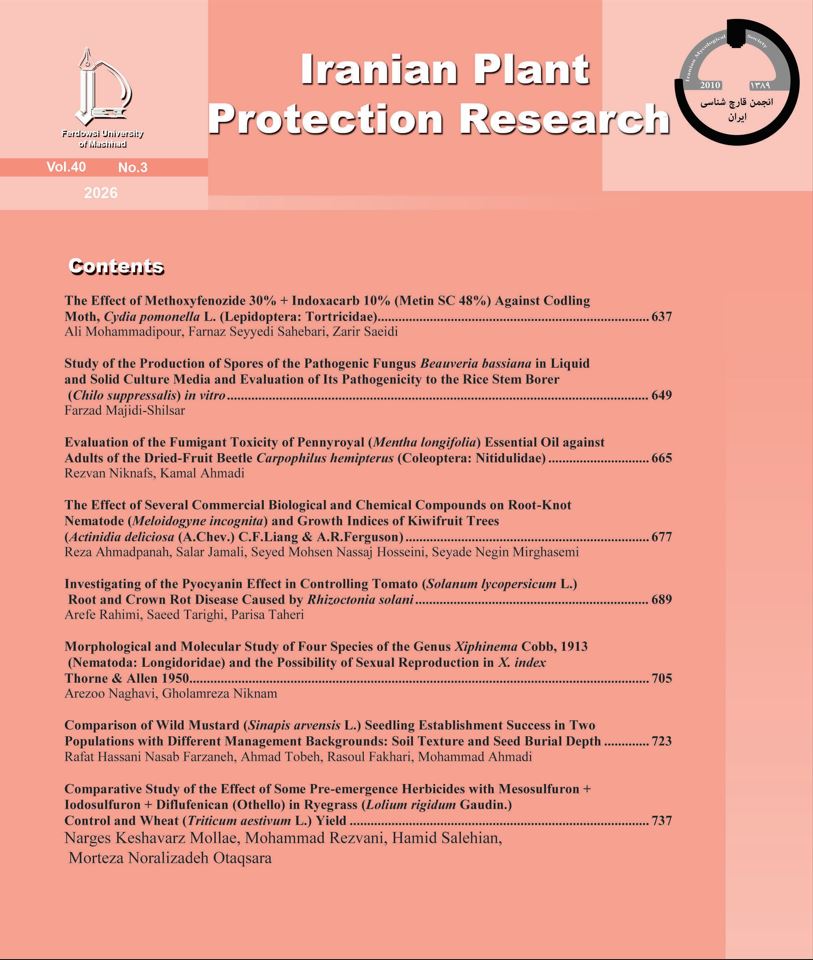
Document Type : Research Article
Authors
Department of Plant Protection, Faculty of Agriculture, Ferdowsi University of Mashhad, Mashhad, Iran
Abstract
Introduction[1]
Tomato (Solanum lycopersicum L.) is among the most important vegetable crops worldwide due to its substantial nutritional value, economic relevance, and extensive consumption. However, tomato production is continuously challenged by numerous soil-borne pathogens, among which Rhizoctonia solani AG4-HG II is recognized as a major causal agent of root and crown rot. This pathogen can severely damage the root system, restrict nutrient uptake, and ultimately lead to plant collapse, resulting in significant yield loss. Conventional chemical fungicides, although widely used, present serious limitations, including environmental risks, development of resistance, and potential negative effects on beneficial soil microbiota. Consequently, biological control strategies, especially those involving plant growth promoting rhizobacteria (PGPR), have emerged as sustainable alternatives. Among PGPR, Pseudomonas aeruginosa is known for synthesizing diverse secondary metabolites, including phenazine compounds with strong antimicrobial properties. Pyocyanin, a blue-green phenazine pigment, has been widely studied for its antibacterial and antifungal effects. Despite the growing interest in this metabolite, its specific antagonistic activity against R. solani AG4-HG II and its influence on tomato plant performance have not been adequately addressed. To fill this knowledge gap, the present research aimed to isolate and purify pyocyanin from P. aeruginosa PA14, evaluate its antifungal efficiency, and determine its potential as a biological control agent against tomato root and crown rot. This study was carried out at Ferdowsi University of Mashhad between 2023 and 2025.
Materials and Methods
Pseudomonas aeruginosa PA14 and Rhizoctonia solani AG4-HG II were cultured under standard laboratory conditions to obtain fresh and active microbial material. Pyocyanin was extracted from the bacterial supernatant using a chloroform based solvent extraction followed by acid-base purification to obtain a purified pigment. To evaluate the antifungal activity of pyocyanin, a single-sided plate culture assay was performed on potato dextrose agar (PDA). The minimum inhibitory concentration (MIC) was defined as the lowest concentration of pyocyanin that completely inhibited fungal growth. To assess morphological changes caused by pyocyanin, fungal hyphae from the treated plates were examined under a light microscope, and structural abnormalities such as swelling, fragmentation, or collapse of the cell wall were recorded. In the greenhouse experiment, tomato seedlings were treated with pyocyanin at a concentration of 83.33 µg/mL and subsequently inoculated with R. solani. Statistical analyses were conducted using analysis of variance (ANOVA), and differences among means were determined using Duncan’s multiple range test at P < 0.05.
Results and Discussion
Pyocyanin extracted from Pseudomonas aeruginosa PA14 demonstrated a significant inhibitory effect on the growth of Rhizoctonia solani AG4-HG II, with a minimum inhibitory concentration (MIC) of 83.33 µg mL-1. Microscopic observations revealed notable morphological alterations in fungal hyphae treated with pyocyanin, including swelling, fragmentation, and cytoplasmic degradation, indicating severe damage to the fungal structures. These findings confirm the potent antifungal properties of pyocyanin and its direct antagonistic effect on the pathogen. In greenhouse trials, treatment with pyocyanin led to a marked reduction in disease severity in tomato seedlings and leaf discs inoculated with R. solani. Based on these observations, it is evident that pyocyanin functions as a highly effective antifungal metabolite capable of disrupting key infection structures of the pathogen. The consistency between in vitro and greenhouse results further supports the reliability of pyocyanin as a biocontrol agent. These outcomes align with previous reports showing that phenazine compounds produced by Pseudomonas species suppress soil-borne pathogens through direct mycelial disruption and inhibition of fungal development. Overall, the strong antagonistic activity of pyocyanin highlights its promising potential for use in sustainable and environmentally friendly disease management strategies aimed at reducing reliance on chemical fungicides.
Conclusion
This study demonstrated that pyocyanin extracted from Pseudomonas aeruginosa PA14 effectively controlled tomato root and crown rot caused by Rhizoctonia solani AG4-HG II by inhibiting fungal growth, disrupting infection structures, and enhancing the plant’s systemic resistance. In addition to its direct antifungal activity, pyocyanin contributed to improved plant health under pathogen pressure. The dual mode of action of pyocyanin as both a bioactive compound directly antagonizing the pathogen and as an inducer of plant defense mechanisms highlights its potential as a sustainable and eco-friendly alternative to conventional chemical fungicides. However, while the greenhouse results are promising, further studies under field conditions are essential to validate its practical applicability. Moreover, elucidating the molecular and biochemical pathways involved in pyocyanin-induced resistance would deepen understanding and support the development of effective biocontrol strategies. Overall, pyocyanin represents a valuable biocontrol agent with significant potential for managing soil-borne diseases in tomato and possibly other crops, contributing to sustainable agriculture and reduced reliance on chemical inputs.
Keywords
Subjects