Journal of Iranian Plant Protection Research

Journal of Iranian Plant Protection Research

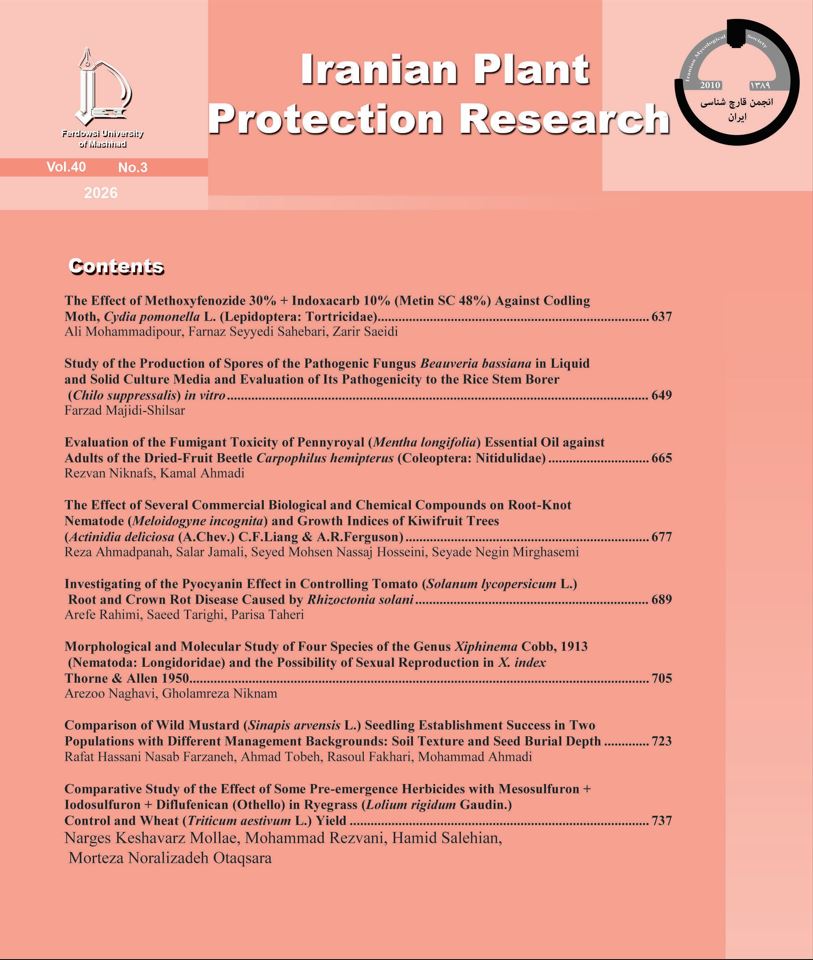
Comparison of Wild Mustard (Sinapis arvensis L.) Seedling Establishment Success in Two Populations with Different Management Backgrounds: Soil Texture and Seed Burial Depth

Document Type : Research Article

Authors
1 Department of Genetic and Plant Production, Faculty of Agriculture and Natural Resources, University of Mohaghegh Ardabili, Ardabil, Iran
2 Plant Protection Research Department, Ardabil Agricultural and Natural Resources Research and Education Centre, AREEO, Moghan, Iran
Abstract
Introduction
Wild mustard (Sinapis arvensis L.) is a highly competitive and widespread weed in global agricultural systems. Its high ecophysiological adaptability and ability to form a persistent seed bank consistently pose a serious threat to crop production. The ecological success of this plant is largely attributed to its complex adaptive mechanisms in response to environmental factors such as sowing depth and soil texture. Understanding these mechanisms is fundamental for developing effective and sustainable management strategies. Previous studies have well-established that sowing depth is a critical factor determining seedling emergence. Generally, smaller seeds, like those of wild mustard, are dependent on being placed at shallow depths for germination due to their limited seed reserves. This study specifically addresses the question of whether a critical depth can be identified for managing any population in any soil type, beyond which the potential for seedling establishment approaches zero.

Materials and Methods
In the autumn of 2023, a factorial experiment arranged in a completely randomized design (CRD) with three replications was conducted to investigate the emergence and establishment indices of wild mustard seedlings. The factors included wild mustard population at 2 levels (A and B to tribenuron-methyl herbicide), soil type at 2 levels (clay and silt textures), and sowing depth at 8 levels (0, 1, 2, 3, 4, 5, 6, and 7 cm). Seeds of both A and B populations were collected in the spring of 2023 from fields around the University of Mohaghegh Ardabili greenhouse, where they had been cultivated. To break physiological dormancy, seeds were pre-treated with Gibberellic acid (GA₃) at a concentration of 1500 parts per million (ppm).

Results and Discussion
Findings revealed that although the population of B demonstrated superiority under optimal conditions (shallow depths and clay soil) with a high emergence index (24.5), this genetic advantage is entirely fragile in the face of the determining factor of seed placement depth. Identifying a critical physiological threshold at 4-5 cm depth is considered key to controlling this weed; this is the depth at which even the most population of B, in an unequal battle against darkness and soil mechanical pressure, exhausts its energy reserves before reaching the light and fails to emerge. The population of B achieved the highest survival percentage (98.61%) and the highest emergence rate (emergence index 16.50) at 1 cm depth in clay soil. At 1 cm depth, the mean emergence percentage in clay soil was 98.66% for both populations, while in silt soil it reached 84% for The population of B. At a 6 cm depth in silt soil, the survival percentage of the population of A was 0%, highlighting the detrimental interaction of depth and unfavorable soil texture.

Conclusion
In response to increasing depth, the plant allocates its resources primarily to the rapid elongation of the hypocotyl to escape darkness, rather than to radicle development and biomass production. Furthermore, a strong positive correlation between germination speed and final emergence percentage/seedling survival clearly demonstrated the decisive role of speed in the ultimate success of establishment. Considering the advantage of The population of A at shallow depths, particularly in clay soils, it is recommended to use competitive crops with high shading ability to neutralize this population's germination speed advantage. Additionally, careful monitoring of fields for the presence of resistant populations and selecting seedbeds with appropriate texture can be effective in designing integrated weed management programs. Ultimately, integrating these ecology-based strategies, founded on the findings of this research, can significantly contribute to reducing reliance on herbicides and achieving a more sustainable agricultural system.
Keywords
Subjects

Authors retain the copyright. This is an open access article distributed under Creative Commons Attribution 4.0 International License (CC BY 4.0)

1.       Baskin, C. C., & Baskin, J. M. (2014). Seeds: Ecology, biogeography, and, evolution of dormancy and germination (2nd ed.). Academic Press. https://doi.org/10.1016/C2013-0-00597-X
2.       Benech-Arnold, R. L., & Sánchez, R. A. (2022). Handbook of Seed Physiology: Applications to Agriculture. CRC Press, p. 45-68.
3.       Benech-Arnold, R. L., & Sánchez, R. A. (2023). Modelling the effect of soil depth on weed seed germination and emergence. Agricultural Systems, 205, 103558.
4.       Benech-Arnold, R. L., & Sánchez, R. A. (Eds.). (2017). Handbook of Seed Physiology: Applications to Agriculture. CRC Press
5.       Benvenuti, S. (2003). Soil texture involvement in germination and emergence of buried weed seeds. Agronomy Journal, 95(1), 191-198. https://doi.org/10.2134/agronj2003.1910
6.       Benvenuti, S. (2022). Soil burial and seed size effects on weed seed germination. Weed Research, 62(4), 245-254.
7.       Bewley, J. D., Bradford, K. J., Hilhorst, H. W. M., & Nonogaki, H. (2013). Seeds: Physiology of Development, Germination and Dormancy (3rd ed.). Springer Science & Business Media. https://doi.org/10.1007/978-1-4614-4693-4
8.       Chauhan, B. S., Matloob, A., Mahajan, G., Aslam, F., Florentine, S. K., & Jha, P. (2022). Emerging challenges and opportunities for education and research in weed science. Frontiers in Plant Science, 13, 793703. https://doi.org/10.3389/fpls.2017.01537
9.       Colbach, N., Busset, H., Yamada, O., Dürr, C., & Caneill, J. (2023). Modelling the effects of cropping systems on the seed bank dynamics and the emergence of weed seeds. Field Crops Research, 291, 108788.
10.    Colbach, N., Durr, C., Roger-Estrade, J., & Canelli, J. (2020). How to model the effects of farming practices on weed emergence. Weed Research, 60(2), 121-136. https://doi.org/10.1111/j.1365-3180.2004.00428.x
11.    Finch‐Savage, W. E., & Leubner‐Metzger, G. (2022). Seed germination in soil: Dormancy cycling, sensing and exploitation of seasonal temperature changes. New Phytologist, 234(5), 1591–1600. 
12.    Finch-Savage, W. E., & Bassel, G. W. (2016). Seed vigour and crop establishment: Extending performance beyond adaptation. Journal of Experimental Botany, 67(3), 567–591. https://doi.org/10.1093/jxb/erv490
13.    Forcella, F., Benech-Arnold, R. L., Sanchez, R., & Ghersa, C. M. (2000). Modeling seedling emergence. Field Crops Research, 67(2), 123–139. https://doi.org/10.1016/S0378-4290(00)00088-5
14.    Grundy, A. C., Mead, A., & Burston, S. (2003). Modeling the emergence response of weed seeds to burial depth: implications for weed management. Weed Science, 51(5), 754-761. https://doi.org/10.1046/j.1365-2664.2003.00836.x
15.    Guerresi, M., Bacenetti, J., & Lencioni, G. (2021). Soil physical properties and seedbed preparation: A review. Agronomy, 11(4), 767.
16.    Guillemin, J. P., Gardarin, A., Granger, S., Reibel, C., Munier-Jolain, N., & Colbach, N. (2023). Soil texture effects on weed seed germination and seedling establishment. Soil & Tillage Research, 225, 105543. 
17.    Heap, I. (2024). The international survey of herbicide-resistant weeds. Weed Science, 72(1), 1-15.
18.    Huang, M., & Liu, X. (2024). Environmental dominance over genetic effects in extreme soil conditions: Evidence from root elongation depth thresholds. Plant Physiology, 195(2), 801-815.
19.    International Seed Testing Association. )2023(. International Rules for Seed Testing. Chapter 5: Seed Vigour Testing Methods, pp. 501–525. Bassersdorf, Switzerland.
20.    Kaya, I., & Çıkılı, Y. (2020). Influence of soil texture and salinity on seed germination and seedling growth of Convolvulus arvensis. Weed Biology and Management, 20(1), 45–53.
21.    Larcher, W. (2003). Physiological Plant Ecology: Ecophysiology and Stress Physiology of Functional Groups. 4th Edition. Springer-Verlag, Berlin. pp. 213-215.
22.    Nguyen, T. H., & Smith, D. L. (2023). Compensatory mechanisms in herbicide-resistant weed biotypes. Weed Science, 71(3), 234-245.
23.    Poorter, H., Niklas, K. J., Reich, P. B., Oleksyn, J., Poot, P., & Mommer, L. (2012). Biomass allocation to leaves, stems and roots: Meta-analyses of interspecific variation and environmental control. New Phytologist, 193(1), 30–50. https://doi.org/10.1111/j.1469-8137.2011.03952.x
24.    Vidotto, F., Fogliatto, S., Milan, M., & De Palo, F. (2024). Biotype-specific responses to environmental factors in Sinapis arvensis L. Pest Management Science, 80(2), 456-468. 
25.    Zhang, H., Huang, Y., Li, Y., Wang, H., & Li, J. (2024). Ecological-based integrated weed management: Current status and future perspectives. Agronomy for Sustainable Development, 44(1), 12. 
Send comment about this article
Enter Name.
Enter a valid email address.
Enter a vaid affiliation.
Enter comments (At leaset 10 words)
CAPTCHA Image
Enter Security Code Correctly.